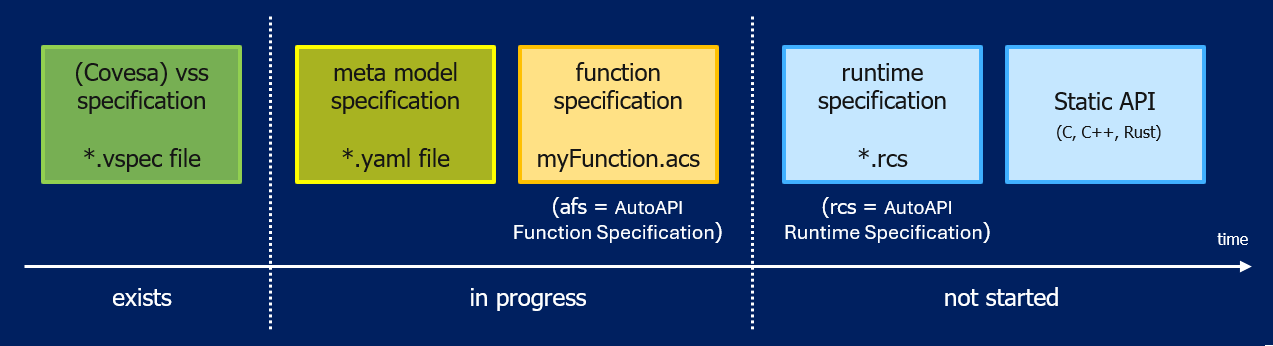
Current status of the project:
Software Architecture#
Runtime Specification File#
A Function Specification File fully describes exactly one function in isolation: its signals, its parameters, and the scheduling of its own runnables. It intentionally does not know anything about the other functions running on the same system.
A real system, however, is composed of several such functions that need to be instantiated and executed together, in a defined order, and connected to the same middleware. The Runtime Specification File captures this system-level composition on top of one or more Function Specification Files:
Function reference - which Function Specification Files (i.e. which functions) are part of this runtime/system.
Sequencing - the execution order across those functions, i.e. how the
previousRunnableRefchains of the individual functions are stitched together into one overall schedule.
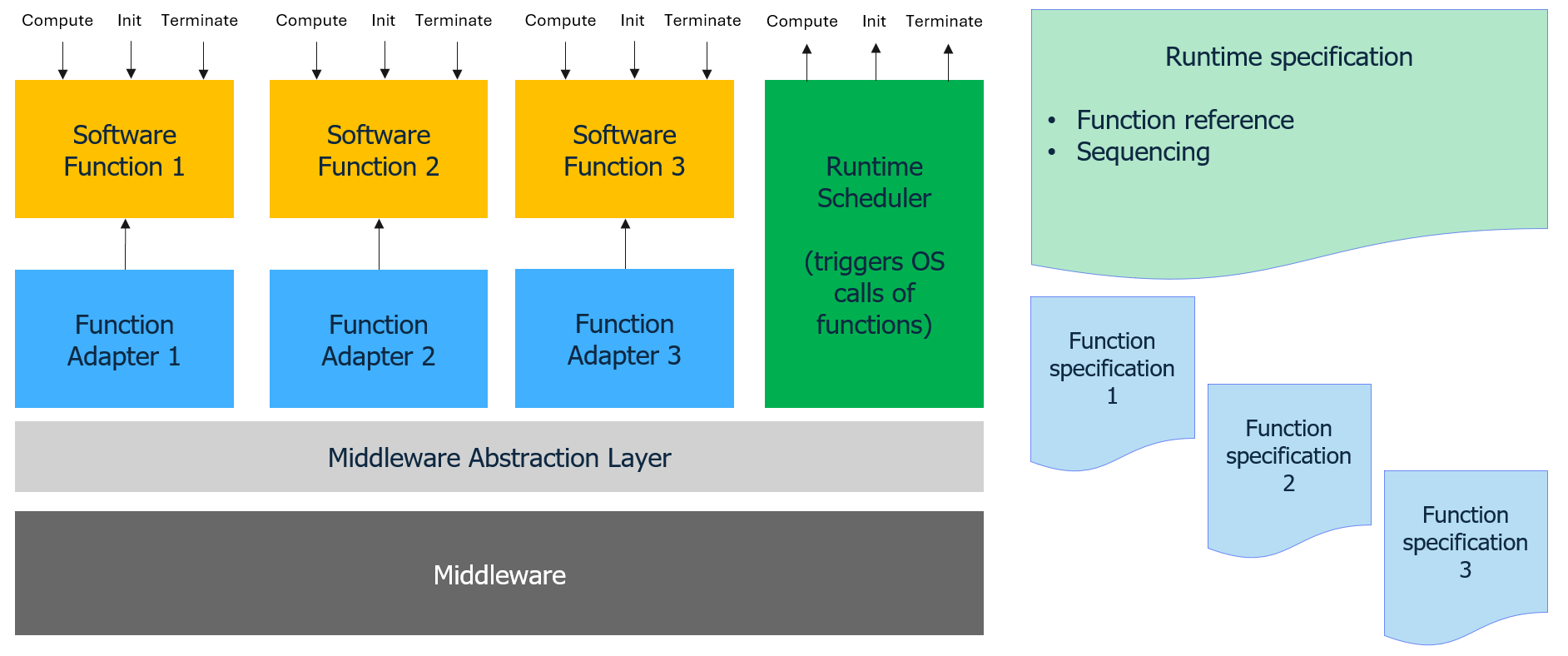
As shown above, each Software Function (the function’s business logic) is executed through its own Function Adapter, which wraps it
behind the stable, middleware-independent contract defined by the meta model. The Runtime Scheduler is generated from the Runtime
Specification File and is responsible for triggering the OS-level Init/Compute/Terminate calls of every function, in the order
described by the Runtime Specification File, through the Middleware Abstraction Layer.
Note
The Runtime Specification File is not yet formally defined in the meta model (unlike the Function Specification File, which is defined by
Eclipse-autoapiframework-Metamodel version 0.4.0). The concepts above describe the intended scope; a versioned schema, file extension,
and worked examples are still to be added.
Open topics still to be worked out for the Runtime Specification File:
Mapping of an output signal of one function to the input signal of another (data flow / connections).
Explicit dependency declarations between functions, beyond the ordering implied by
previousRunnableRef.Initialization / system setup information.
Deployment information.