Current status of the project
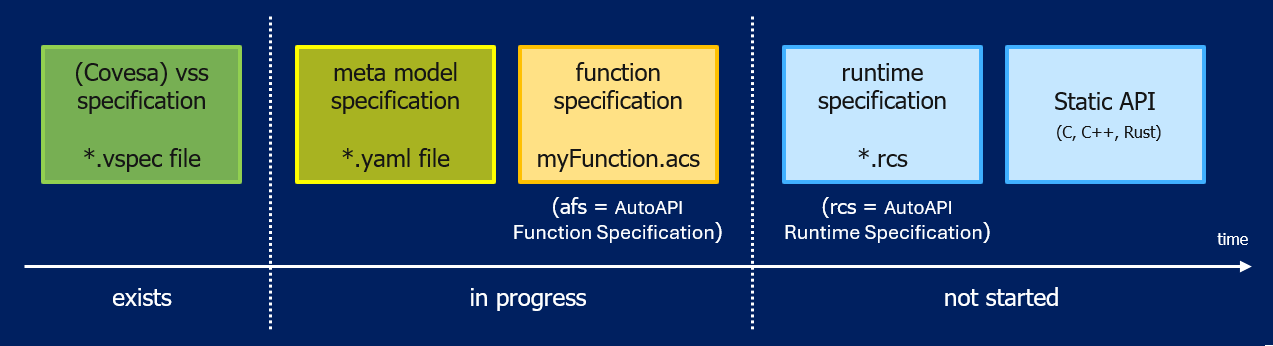
Meta Model#
The meta model defines middleware-independent metadata for the definition and generation of standardized function APIs. Catalogue/interface metadata, for example metadata originating from COVESA VSS or an extended catalogue, is separated from function-specific configuration and runtime state where applicable.
The current core interface types are Data, Parameter, Scheduling, and a candidate Error interface. The model also defines common enumerations, runtime companion information for data quality, execution-result semantics, and cross-cutting modelling rules.
For Data and Parameter interfaces, name is the unique interface identifier.
The value follows the canonical hierarchical naming convention and therefore a
separate path property is not used.
Enum Type Description#
The meta model defines common enum types used by interface properties and runtime information.
Enum |
Values |
Purpose |
|---|---|---|
ASIL |
|
Safety classification used where an interface or runnable is safety-relevant. |
DataQuality |
|
Runtime qualifier values. |
Direction |
|
Function-relative direction of a Data interface. |
RunType |
|
Activation type of a runnable. |
ProtectionType |
|
Abstract protection requirement. Concrete middleware protection details are platform/deployment-specific. |
FunctionResult |
|
Generic execution result only. It does not encode function-specific diagnostic causes. |
ErrorSeverity |
|
Functional impact/severity associated with a function-specific Error interface. |
SupervisionType |
|
Types of runnable execution supervision represented by the meta model. |
FunctionResult#
FunctionResult represents the generic outcome of an execution. It shall be
limited to success, failure, or notAvailable and shall not replace
function-specific diagnostic/error interfaces.
An adapter may report a failure it can observe, for example an invocation,
transport, or timeout failure. It shall not synthesize detailed
function-internal diagnostic causes or use FunctionResult as fault-logging
information.
Data Type Description#
Standard Naming Convention: Vehicle.<Domain/Subdomains>.<Signal>
name contains the complete canonical interface identifier, for example
Vehicle.Speed. A separate path property is not used.
Property / Attribute |
Req. |
Datatype |
Description |
Example / Notes |
|---|---|---|---|---|
name |
Yes |
string |
Unique interface or node name based on the canonical VSS path of the Data interface. |
|
dataType |
Yes |
string |
Type of value transported by the interface. |
|
description |
Yes |
string |
Functional meaning of the Data interface. |
Vehicle longitudinal speed |
unit |
Yes |
string |
Engineering unit of the Data interface. |
|
min |
Yes |
number |
Engineering minimum representable value. |
|
max |
Yes |
number |
Engineering maximum representable value. |
|
defaultValue |
Yes |
any |
Default or initialization value, where defined. |
|
resolution |
Yes |
number |
Smallest measurable quantization value, for example for scaling. |
|
precision |
Yes |
number |
Required numeric precision or number of meaningful digits. |
|
FuSa |
Yes |
boolean |
Indicates whether the Data interface is safety-relevant. |
|
ASIL |
No |
enum: ASIL |
Safety classification associated with the Data interface when it is safety-relevant. |
|
minUpdatePeriodMs |
Yes |
uint16 |
Minimum interval between Data updates in milliseconds. |
|
accuracy |
Yes |
string |
Expected measurement or estimation accuracy. |
|
direction |
Yes |
enum: Direction |
Input/output relationship relative to the function using the interface. It shall not be inferred from the VSS sensor/actuator type. |
|
protection |
Yes |
enum: ProtectionType |
Protection requirement for transfer of the Data between the function and its adapter/platform. Detailed realization is binding-specific. |
|
Runtime Data Quality#
qualityCode is runtime companion information and is intentionally separated
from the static Data metadata.
Property |
Datatype |
Generation |
Description |
|---|---|---|---|
qualityCode |
enum: DataQuality |
Separate runtime information |
Runtime quality/validity information accompanying the Data value. Recommended naming is |
A static function specification shall therefore not contain a constant such as
qualityCode: valid as if it were immutable interface metadata.
Parameter Type Description#
Standard Naming Convention: Vehicle.<Domain/Subdomains>.<Parameter>
name contains the complete canonical parameter identifier. A separate
path property is not used.
Property / Attribute |
Req. |
Datatype |
Description |
Example / Notes |
|---|---|---|---|---|
name |
Yes |
string |
Unique parameter name based on the canonical VSS path of the Parameter interface. |
|
dataType |
Yes |
string |
Datatype of the parameter value. |
|
defaultValue |
Yes |
any |
Default parameter value. |
|
description |
Yes |
string |
Meaning and intended usage of the parameter. |
Gain for a calibration map |
unit |
Yes |
string |
Engineering unit where applicable. |
|
tunable |
Yes |
boolean |
Indicates whether the parameter may be tuned/configured after definition. |
|
min |
Yes |
number |
Minimum permitted parameter value, if defined/applicable. |
|
max |
Yes |
number |
Maximum permitted parameter value, if defined/applicable. |
|
dimensions |
No |
array shape |
Shape of an array/map parameter. Omitted for scalars. |
|
Scheduling Type Description#
Standard Naming Convention: <FunctionName>.Init,
<FunctionName>.Step, <FunctionName>.Terminate
Scheduling defines the lifecycle, activation, timing, and execution-supervision contract of a runnable.
Property / Attribute |
Req. |
Datatype |
Description |
Example / Notes |
|---|---|---|---|---|
functionName |
Yes |
string |
Runnable or callable function name. |
|
runType |
Yes |
enum: RunType |
Activation type of the runnable. |
|
description |
Yes |
string |
Purpose and execution intent of the runnable. |
Main cyclic calculation |
cycleTimeMs |
Conditional |
number |
Periodicity of cyclic execution in milliseconds. |
Required when |
implementedASIL |
Yes |
enum: ASIL |
ASIL level for which this runnable/execution is implemented. |
|
previousRunnableRef |
No |
string |
Runnable that must precede this runnable when an ordering constraint exists. |
|
schedulingPolicy |
No |
string |
Scheduling mechanism or constraint. |
|
supervision |
Yes |
object |
Defines whether execution supervision is required and which supervision types/configuration apply. |
|
stackSizeBytes |
No |
uint32 |
Required stack size when relevant for deployment/integration. |
Platform/deployment-specific |
executionResult |
Yes |
enum: FunctionResult |
Generic result returned/reported for function execution. |
|
Execution Supervision#
The supervision object indicates whether runtime execution monitoring is required. If supervision is required, one or more monitoring types are selected and the corresponding configuration is supplied.
Property |
Req. |
Datatype |
Description |
|---|---|---|---|
supervision.required |
Yes |
boolean |
Indicates whether execution supervision is required for the runnable. |
supervision.type |
Conditional |
enum[] |
Required when |
supervision.alive |
Conditional |
object |
Required when |
supervision.deadline |
Conditional |
object |
Required when |
supervision.logical |
Conditional |
object |
Required when |
Alive Supervision#
Property |
Req. |
Datatype |
Description |
|---|---|---|---|
minIndications |
No |
uint32 |
Minimum allowed number of alive indications in the reference cycle. |
maxIndications |
No |
uint32 |
Maximum allowed number of alive indications in the reference cycle. |
referenceCycleMs |
No |
number |
Reference cycle used to evaluate alive indications. |
Deadline Supervision#
Property |
Req. |
Datatype |
Description |
|---|---|---|---|
minExecutionTimeMs |
No |
number |
Optional minimum execution-time boundary. |
maxExecutionTimeMs |
Yes |
number |
Maximum allowed execution time for deadline supervision. |
Logical Supervision#
Property |
Req. |
Datatype |
Description |
|---|---|---|---|
predecessorRefs |
No |
string[] |
References to runnables expected before the supervised runnable. |
successorRefs |
No |
string[] |
References to runnables expected after the supervised runnable. |
Note
The top-level SupervisionType enum additionally contains none and
combined. The current supervision.type property in the YAML directly
lists alive, deadline, and logical.
Error Type Description#
The Error interface is currently marked as candidate. It represents
function-specific diagnostic/error information and is separated from the
generic FunctionResult. It shall not be confused with ECU-specific DTC or
event-memory configuration.
Standard Naming Convention:
<FunctionName>.<ErrorName>.ErrorStatus
Property / Attribute |
Req. |
Datatype |
Description |
Example / Notes |
|---|---|---|---|---|
name |
Yes |
string |
Function-specific Error interface name. |
|
dataType |
Yes |
string |
Datatype of the exposed Error interface. |
|
description |
Yes |
string |
Meaning of the Error and its trigger scenario. |
Range error due to implausible input |
severity |
Yes |
enum: ErrorSeverity |
Functional impact/severity associated with the Error. |
|
maturationTimeMs |
Yes |
number (ms) |
Time the Error condition must persist before it is asserted/logged by the underlying middleware. |
|
resetTimeMs |
Recommended |
number |
De-maturation/reset time before clearing the Error. |
|
resetCondition |
Recommended |
string |
Condition that clears the Error. |
Input valid for a defined duration |
dependencyRefs |
No |
string[] |
Related upstream Error interfaces that may propagate/trigger this Error. |
|
fallbackBehavior |
No |
string |
Function-level fallback/degradation behavior associated with the Error. |
|
raisesSafetyReactionRefs |
No |
string[] |
References to safety reactions associated with this Error. |
|
Modeling Rules#
The following cross-cutting rules apply to the meta model.
Rule |
Definition |
|---|---|
MR-001 |
VSS sensor/actuator type and function input/output direction are different concepts. Direction shall be assigned per function-interface usage. |
MR-002 |
Runtime quality shall not be populated as a static constant in a function specification. Quality information shall be transported/represented at runtime. |
MR-003 |
Generic |
MR-004 |
Protection indicates a requirement at function-configuration level; concrete middleware-specific protection realization belongs to platform/deployment binding. |
MR-005 |
Unknown metadata shall remain |
Meta Model File#
Version 0.4
  1# *******************************************************************************
  2# Copyright (c) 2026 ZF Friedrichshafen AG
  3#
  4# See the NOTICE file(s) distributed with this work for additional
  5# information regarding copyright ownership.
  6#
  7# This program and the accompanying materials are made available under the
  8# terms of the Apache License Version 2.0 which is available at
  9# https://www.apache.org/licenses/LICENSE-2.0
 10#
 11# SPDX-License-Identifier: Apache-2.0
 12#
 13# Contributors:
 14#   Saran Gundlapalli - Error handling added
 15# *******************************************************************************
 16
 17metamodel:
 18  name: Eclipse-autoapiframework-Metamodel
 19  version: 0.4.0
 20  scope: Middleware-independent metadata for definition and generation of standardized function APIs. Catalogue/interface metadata (fro e.g., from VSS) is separated from function-specific configuration and runtime state where applicable.
 21  intent: Core interface types and essential metadata are required for standardized API definition and generation.
 22
 23  enums:
 24
 25    ASIL:
 26      - QM
 27      - A
 28      - B
 29      - C
 30      - D
 31
 32    DataQuality:
 33      description: Runtime qualifier values. DataQuality is defined by the metamodel and the attribute qualityCode is not static metadata of a data interface instance.
 34      values:
 35        - uninitialized
 36        - invalid
 37        - valid
 38
 39
 40    Direction:
 41      - input
 42      - output
 43
 44    RunType:
 45      - init
 46      - cyclic
 47      - event
 48      - terminate
 49
 50    ProtectionType:
 51      description: Abstract protection requirement. Concrete middleware protection profile and binding details may be defined during platform/deployment configuration.
 52      values:
 53        - none
 54        - complement
 55        - other
 56
 57    FunctionResult:
 58      description: Generic execution result only. It shall not encode function-specific diagnostic causes. Detailed errors are exposed through "Error interfaces".
 59      values:
 60        - success
 61        - failure
 62        - notAvailable
 63
 64    ErrorSeverity:
 65      - information
 66      - warning
 67      - degraded
 68      - shutdown
 69
 70    SupervisionType:
 71      - none
 72      - alive
 73      - deadline
 74      - logical
 75      - combined
 76
 77  interfaceTypes:
 78
 79    Data:
 80      description: Runtime data interfaces exchanged between applications or systems. Semantic properties may originate from VSS or an extended catalogue. Direction and protection are resolved for the function usage/configuration and are not intrinsic properties of the canonical VSS node.
 81
 82      properties:
 83        name:
 84          mandatory: true
 85          datatype: string
 86          description: Unique interface or node name. Based on canonical VSS path of the data interface - Vehicle.<Domain/Subdomains>.<Signal>
 87          example: Vehicle.Speed
 88
 89        dataType:
 90          mandatory: true
 91          datatype: string
 92          description: Type of value transported by the interface.
 93          examples:
 94            - float
 95            - uint8
 96            - uint16
 97            - boolean
 98
 99        description:
100          mandatory: true
101          datatype: string
102          description: Functional meaning of the data interface.
103
104        unit:
105          mandatory: true
106          datatype: string
107          description: Engineering unit of the data interface.
108          example: km/h
109
110        min:
111          mandatory: true
112          datatype: number
113          description: Engineering minimum representable value. Null if not yet defined or not applicable.
114
115        max:
116          mandatory: true
117          datatype: number
118          description: Engineering maximum representable value. Null if not yet defined or not applicable.
119
120        defaultValue:
121          mandatory: true
122          datatype: any
123          description: Default or initialization value, where defined. Null if not yet defined or not applicable.
124
125        resolution:
126          mandatory: true
127          datatype: number
128          description: Smallest measurable quantization value - meant for scaling etc.
129
130        precision:
131          mandatory: true
132          datatype: number
133          description: Required numeric precision/number of meaningful digits.
134
135        FuSa:
136          mandatory: true
137          datatype: boolean
138          description: Indicates if the data interface is safety relevant or not.
139
140        ASIL:
141          mandatory: false
142          datatype: enum
143          enumRef: ASIL
144          description: Safety classification associated with the data interface when it is safety-relevant.
145
146        minUpdatePeriodMs:
147          mandatory: true
148          datatype: uint16
149          description: Minimum interval between data updates in milliseconds.
150
151        accuracy:
152          mandatory: true
153          datatype: string
154          description: Expected measurement or estimation accuracy.
155          example: ±0.2 km/h
156
157        direction:
158          mandatory: true
159          datatype: enum
160          enumRef: Direction
161          description: Input/output relationship relative to the function using the interface. This shall not be inferred from the VSS sensor/actuator type.
162          example: input
163
164        protection:
165          mandatory: true
166          datatype: enum
167          enumRef: ProtectionType
168          description: Protection requirement for transfer of the data between the function and its adapter/platform. Detailed realization is binding-specific.
169          example: complement
170
171      runtimeCompanion:
172        qualityCode:
173          generatedAsSeparateRuntimeInformation: true
174          recommendedNaming: "<DataPath>.Qualifier"
175          datatype: enum
176          enumRef: DataQuality
177          description: Runtime quality/validity information accompanying the value. It is not a static metadata value such as min,max etc.
178          example: Vehicle.Speed.Qualifier
179
180    Parameter:
181      description: Calibration and configuration interface.
182
183      properties:
184        name:
185          mandatory: true
186          datatype: string
187          description: Unique parameter name. Based on canonical VSS path of the parameter - Vehicle.<Domain/Subdomains>.<Parameter>
188          example: Vehicle.Brake.Gain
189
190        dataType:
191          mandatory: true
192          datatype: string
193          description: Datatype of the parameter value.
194          examples:
195            - float
196            - float[]
197            - uint8
198            - boolean
199
200        defaultValue:
201          mandatory: true
202          datatype: any
203          description: Default parameter value.
204
205        description:
206          mandatory: true
207          datatype: string
208          description: Meaning and intended usage of the parameter.
209
210        unit:
211          mandatory: true
212          datatype: string
213          description: Engineering unit where applicable.
214
215        tunable:
216          mandatory: true
217          datatype: boolean
218          description: Indicates whether the parameter may be tuned/configured after definition.
219
220        min:
221          mandatory: true
222          datatype: number
223          description: Minimum permitted parameter value, if defined/applicable.
224
225        max:
226          mandatory: true
227          datatype: number
228          description: Maximum permitted parameter value, if defined/applicable.
229
230        dimensions:
231          mandatory: false
232          datatype: any with array indicated via []
233          description: Shape of an array/map parameter. Omitted for scalars; e.g. [10] for a one-dimensional breakpoint vector and [7, 10] for a 7x10 map.
234          example: Vehicle.Brake.GainMap[10]
235
236    Scheduling:
237      description: Lifecycle, activation, timing and execution-supervision contract of a runnable.
238
239      properties:
240        functionName:
241          mandatory: true
242          datatype: string
243          description: Runnable or callable function name.
244          namingConvention:
245            - "<FunctionName>.Init"
246            - "<FunctionName>.Step"
247            - "<FunctionName>.Terminate"
248
249        runType:
250          mandatory: true
251          datatype: enum
252          enumRef: RunType
253          description: Activation type of the runnable.
254
255        description:
256          mandatory: true
257          datatype: string
258          description: Purpose and execution intent of the runnable.
259
260        cycleTimeMs:
261          mandatory: conditional
262          condition: "runType == cyclic"
263          datatype: number
264          description: Periodicity of cyclic execution in milliseconds.
265
266        implementedASIL:
267          mandatory: true
268          datatype: enum
269          enumRef: ASIL
270          description: ASIL level for which this runnable/execution is implemented.
271
272        previousRunnableRef:
273          mandatory: false
274          datatype: string
275          description: Runnable that must precede this runnable when an ordering constraint exists.
276
277        schedulingPolicy:
278          mandatory: false
279          datatype: string
280          description: Scheduling mechanism or constraint, e.g. preemptive/non-preemptive.
281
282        supervision:
283          mandatory: true
284          datatype: object
285
286          properties:
287
288            required:
289              mandatory: true
290              datatype: boolean
291
292            type:
293              mandatory: conditional
294              condition: required == true
295              datatype: enum[]
296              values:
297                - alive
298                - deadline
299                - logical
300
301              alive:
302                mandatory: conditional
303                condition: type contains alive
304                datatype: object
305                properties:
306                minIndications: {datatype: uint32, mandatory: false}
307                maxIndications: {datatype: uint32, mandatory: false}
308                referenceCycleMs: {datatype: number, mandatory: false}
309
310              deadline:
311                mandatory: conditional
312                condition: type contains deadline
313                datatype: object
314                properties:
315                  minExecutionTimeMs: {datatype: number, mandatory: false}
316                  maxExecutionTimeMs: {datatype: number, mandatory: true}
317
318              logical:
319                mandatory: conditional
320                condition: type contains logical
321                datatype: object
322                properties:
323                  predecessorRefs: {datatype: "string[]", mandatory: false}
324                  successorRefs: {datatype: "string[]", mandatory: false}
325
326        stackSizeBytes:
327          mandatory: false
328          datatype: uint32
329          description: Required stack size when relevant for deployment/integration.
330
331        executionResult:
332          mandatory: true
333          datatype: enum
334          enumRef: FunctionResult
335          description: Generic result returned/reported for function execution. The adapter may report a failure indication it can observe (e.g. due to invocation/transport/timeout). It shall not synthesize detailed function-internal diagnostic causes nor reports any errors for fault logging.
336
337    Error:
338      status: candidate
339      description: Function-specific diagnostic/error interface, separated from the generic FunctionResult. This model is a candidate for later standardization and shall not be confused with ECU-specific DTC/event-memory configuration.
340
341      properties:
342        name:
343          mandatory: true
344          datatype: string
345          description: Function-specific error interface name. Standard canonical form - <FunctionName>.<ErrorName>.ErrorStatus
346          example: WheelSpeedCalc.RangeError.ErrorStatus
347
348        dataType:
349          mandatory: true
350          datatype: string
351          description: Datatype of the exposed error interface.
352          examples:
353           - boolean
354           - enum
355
356        description:
357          mandatory: true
358          datatype: string
359          description: Meaning of the error and its trigger scenario.
360
361        severity:
362          mandatory: true
363          datatype: enum
364          enumRef: ErrorSeverity
365          description: Functional impact/severity associated with the error.
366
367        maturationTimeMs:
368          mandatory: true
369          datatype: number in milliseconds
370          description: Time the error condition must persist before the error is asserted/logged by the underlying middleware.
371
372        resetTimeMs:
373          mandatory: false
374          recommendation: recommended
375          datatype: number
376          description: De-maturation/reset time before clearing the error.
377
378        resetCondition:
379          mandatory: false
380          recommendation: recommended
381          datatype: string
382          description: Condition that clears the error.
383
384        dependencyRefs:
385          mandatory: false
386          datatype: "string[]"
387          description: Related upstream error interfaces that may propagate/trigger this error.
388
389        fallbackBehavior:
390          mandatory: false
391          datatype: string
392          description: Function-level fallback/degradation behavior associated with the error.
393
394        raisesSafetyReactionRefs:
395          mandatory: false
396          datatype: "string[]"
397          description: References to safety reactions associated with this error - <SafetyCondition>.SafetyConditionStatus.
398
399  modelingRules:
400    - id: MR-001
401      rule: >-
402        VSS sensor/actuator type and function input/output direction are different
403        concepts. Direction shall be assigned per function-interface usage.
404
405    - id: MR-002
406      rule: >-
407        Runtime quality shall not be populated as a static constant in a function
408        specification. Quality information shall be transported/represented at runtime.
409
410    - id: MR-003
411      rule: >-
412        Generic FunctionResult shall be limited to execution outcome and shall not
413        replace function-specific diagnostic/error interfaces.
414
415    - id: MR-004
416      rule: >-
417        Protection indicates a requirement at function configuration level; concrete
418        middleware specific protection realization belongs to platform/deployment binding.
419
420    - id: MR-005
421      rule: >-
422        Unknown metadata shall remain null according to the consuming schema/tool
423        and shall not be replaced with invented plausible values.
History#
Version |
Author |
Description of Changes |
Impact |
|---|---|---|---|
0.2.0 |
Gundlapalli Saran |
First release of Meta Model specification. |
Baseline |
0.3.0 |
Thomas Pfleiderer |
Signal protection attribute, FunctionResult enum, and typo corrections. |
Functional enhancement |
0.4.0 |
Gundlapalli Saran |
Updated Data and Parameter metadata; separated runtime quality information; moved function-relative direction/protection to Data; added FuSa handling, execution supervision, generic execution-result semantics, candidate Error interface, and modelling rules. |
Architectural and functional enhancement |
Examples#
Example function specifications based on this meta model: